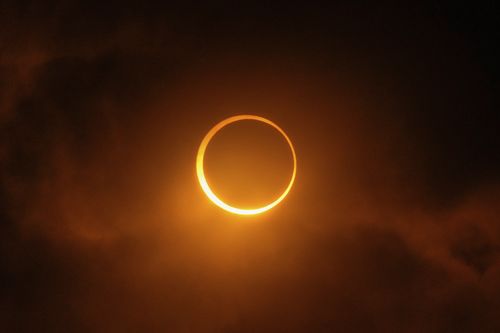
If snapshots of the dazzling "ring of fire" that danced across the skies of
While there won't be another "ring of fire" event until 2026, opportunities to watch the moon obscure some of the sun's surface are around the corner.
Annular solar eclipses like the event that just unfolded occur when the moon passes between earth and the sun. The silvery orb is near or at the farthest point in its orbit from our planet, so it can't completely block the sun as it does during a total solar eclipse. But the alignment allows the moon to blot out most of the sun, creating the stunning "ring of fire" effect.
Two partial solar eclipses will occur next year. A partial solar eclipse happens when the moon moves between the sun and earth without being perfectly aligned, causing the moon to partly obscure the sun and forming a crescent shape.
The first partial solar eclipse next year on March 29, will be visible from a slice of the north-eastern United States and Canada as well as Greenland, Iceland, and parts of Europe and northwest Africa.
A second partial solar eclipse will arrive six months later, on September 21, but only a few lucky nations across Oceania â including a small part of Australia, New Zealand, Fiji â and Antarctica will be able to see the spectacle.
Another annular solar eclipse will arrive on February 17, 2026. The full display will only be visible from Antarctica, but a partial eclipse will still be seen outside the primary path from southern Africa and South America, according to NASA.
Finally, a total solar eclipse â such as the one that drew millions of spectators across North America last April â will once again grace the skies on August 12, 2026.
A total solar eclipse is far different from a partial eclipse or a ring of fire event, as the moon completely covers the sun, casting a shadow that plunges a swath of the earth into darkness for minutes at a time.
The path of totality will cross over Greenland, Iceland, Russia, Spain and a small part of Portugal, while a partial eclipse will be visible in parts of Europe, Africa and North America.
To witness any of these solar eclipse events, be sure to use certified eclipse glasses or a handheld solar viewer to shield your eyes from the sun's harmful rays and observe the event safely.
If you don't have those, you can use a telescope, binoculars or camera that has a special solar filter on the front, which acts the same way eclipse glasses would.
But don't look through any optical device â camera lens, telescope, binoculars â while wearing eclipse glasses or using a handheld solar viewer, according to NASA. Solar rays can still burn through the filter on the glasses or viewer, given how concentrated they can be through an optical device, and can cause severe eye damage.
For globe-trotters eager to see more events, below are dates for other upcoming total solar eclipses and where their paths will traverse:
Australia and New Zealand
Namibia, Botswana, South Africa, Lesotho, Australia
Nigeria, Cameroon, Chad, Sudan, Egypt, Saudi Arabia, Iran, Afghanistan, Pakistan, India, China
China, North Korea, South Korea, Japan
Australia and New Zealand
Angola, the Democratic Republic of Congo, Uganda, Kenya, Somalia
Malaysia, Indonesia, Brunei, the Philippines
Russia

Get competitive quotes on solar and battery systems from trusted Australian installers. HookUpSolar makes it simple.
© Copyright 2026, All right reserved by Hookup Solar